Every skill mapped
Reinforcement Learning on Aristotle is 228 skills across 14 units, each linked to the skills it builds on.

Reinforcement Learning
Pioneered by Stanford AI researchers and learning scientists, Aristotle is the world's first voice-based AI tutor. A full Reinforcement Learning course, mapped skill by skill.
Trusted by families at









Fits your child's Reinforcement Learning class
Reinforcement Learning on Aristotle is 228 skills across 14 units, each linked to the skills it builds on.
Share a syllabus, textbook, or reading list and sessions follow it, or let Aristotle lead the way through the course.
Aristotle moves on when a skill is mastered and slows down when it isn't, so no time goes to what your child already knows.
Features
Talk things through, work side by side, and come back next time to a tutor who remembers where you left off.
Ask questions out loud, hear explanations in Aristotle’s voice, and interrupt whenever you need to.
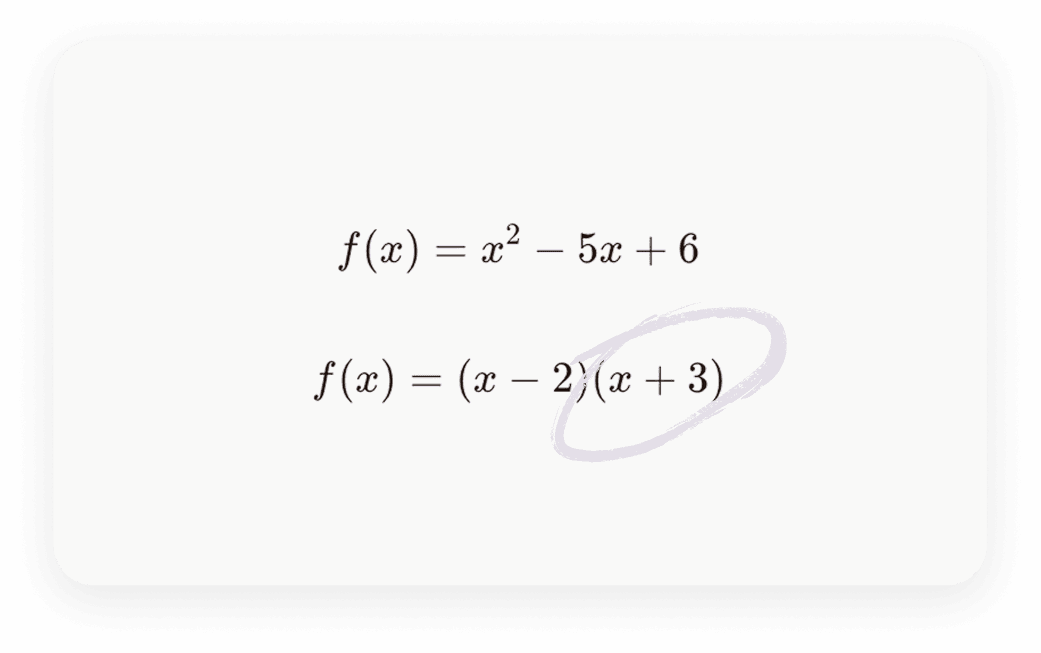
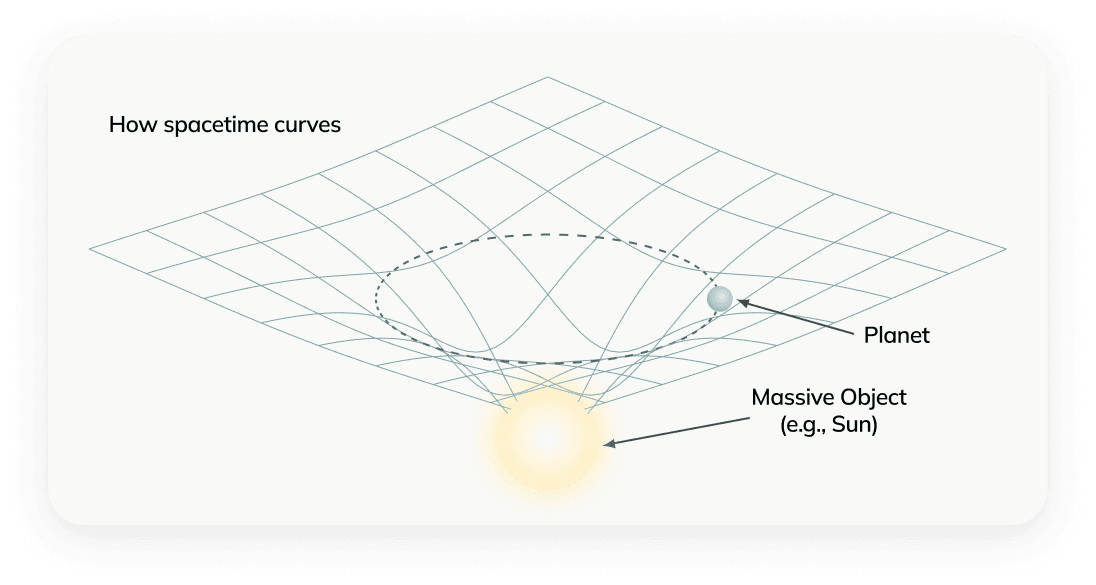
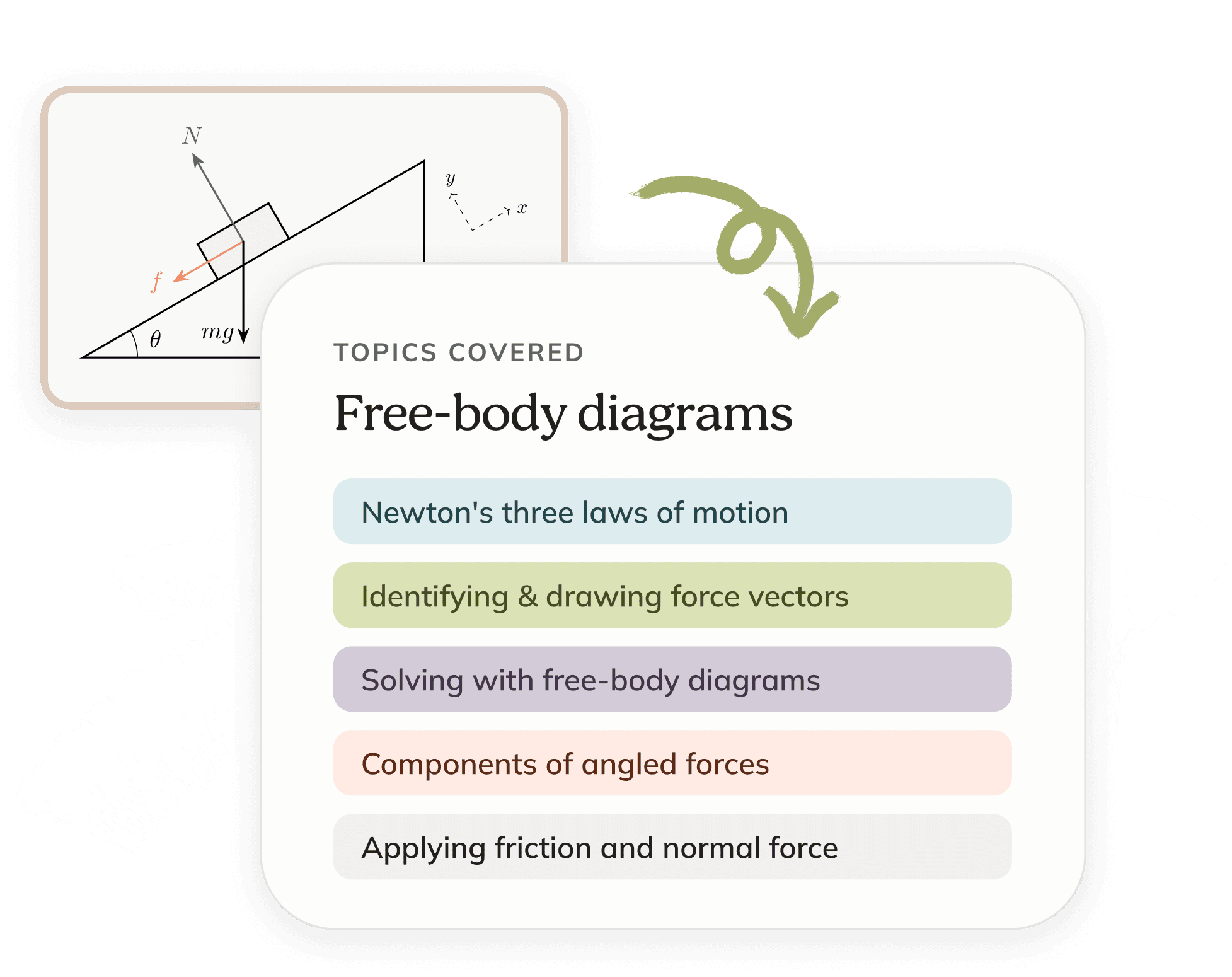
Aristotle draws steps, diagrams, and images to help you learn visually.
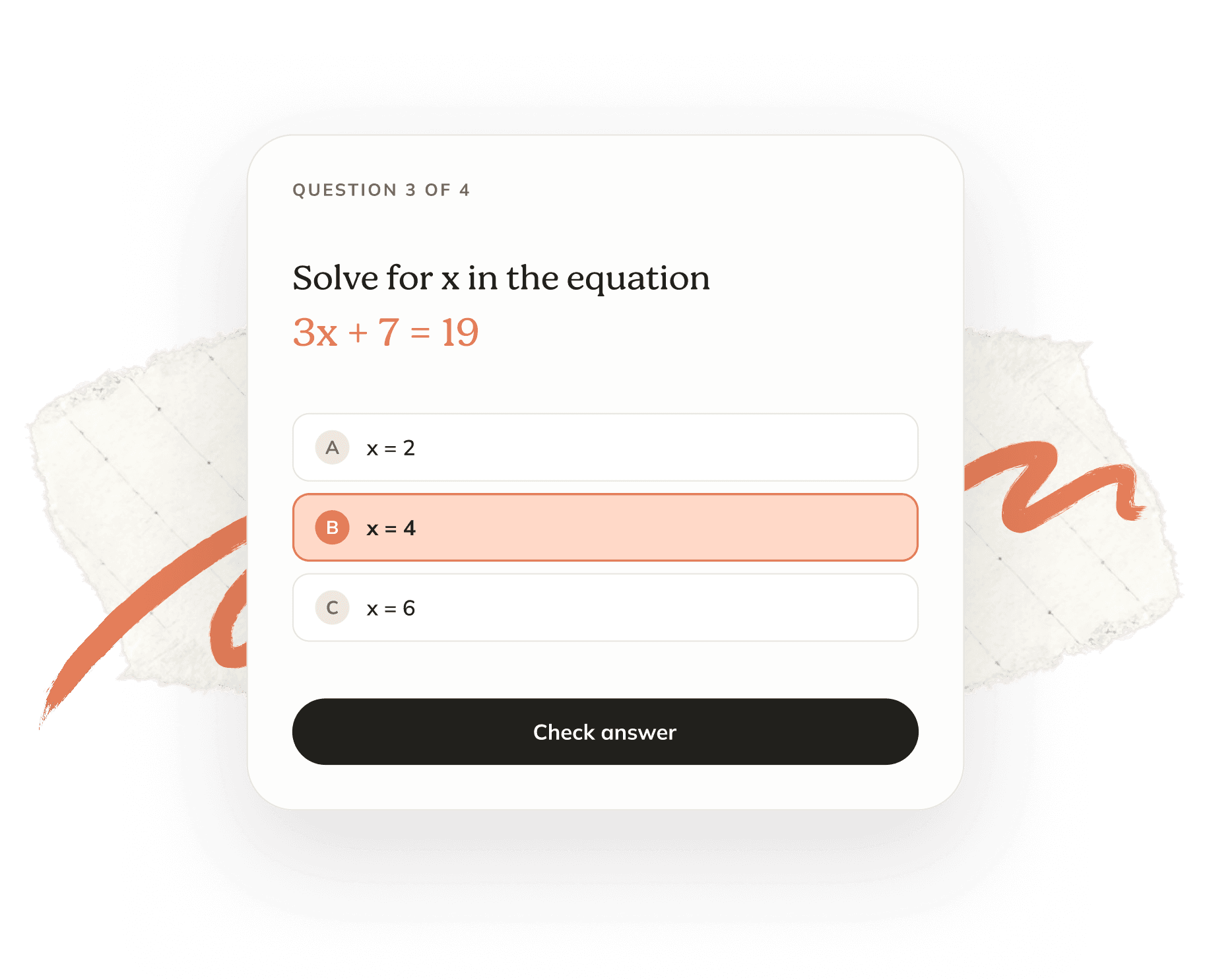
Get practice problems tailored to the exact topics you’re struggling with.
From middle-school math to AP exams to SAT/ACT prep. We also build custom plans matched to state standards and specific courses.
Revisit session summaries, session whiteboards, and uploads in one place.
Aristotle can read and navigate any PDFs and images with the learner. That includes textbooks with hundreds of pages!
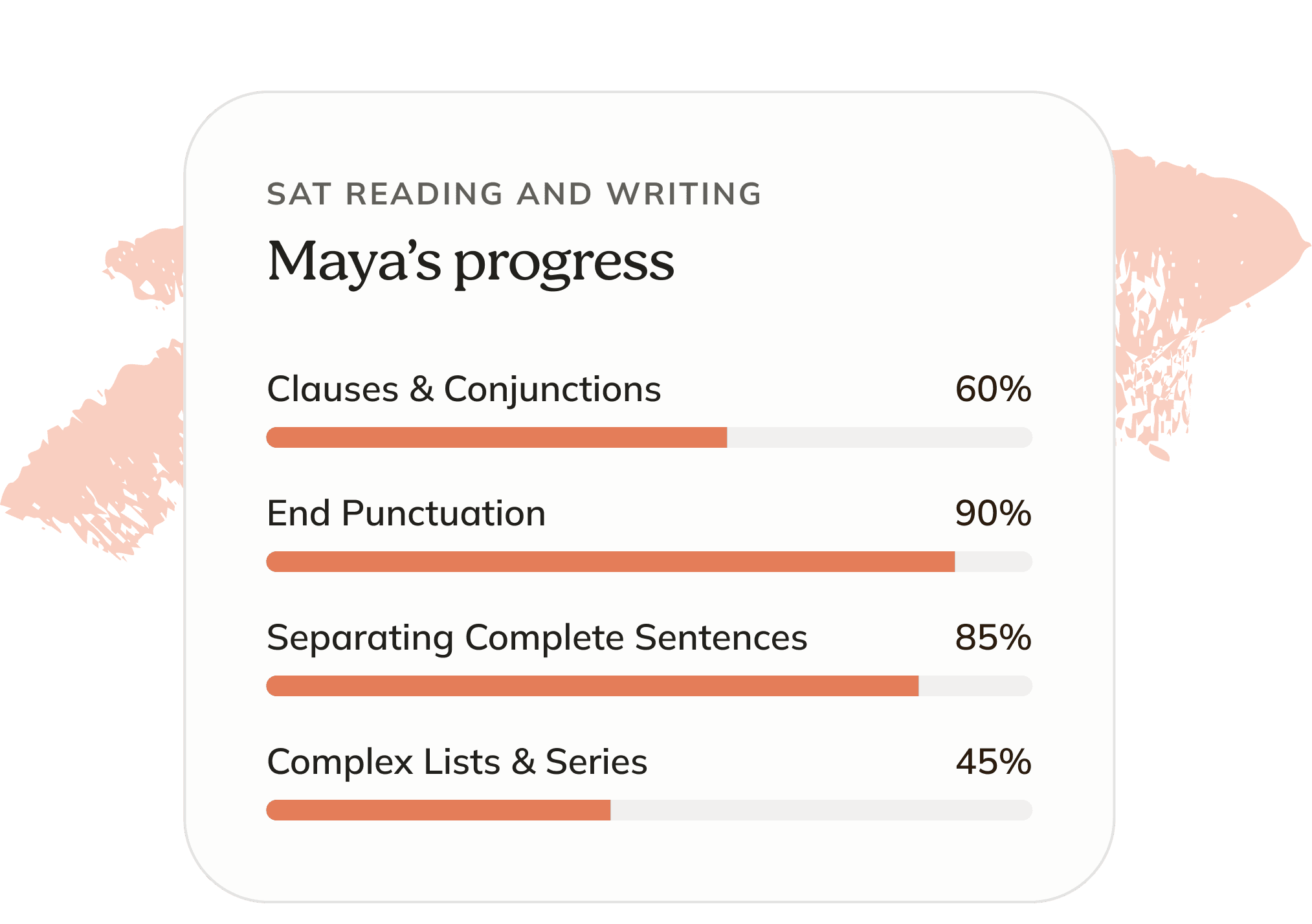
We break all subjects down into granular skills, then track mistakes and mastery on each one. Parents can see the whole picture at a glance.
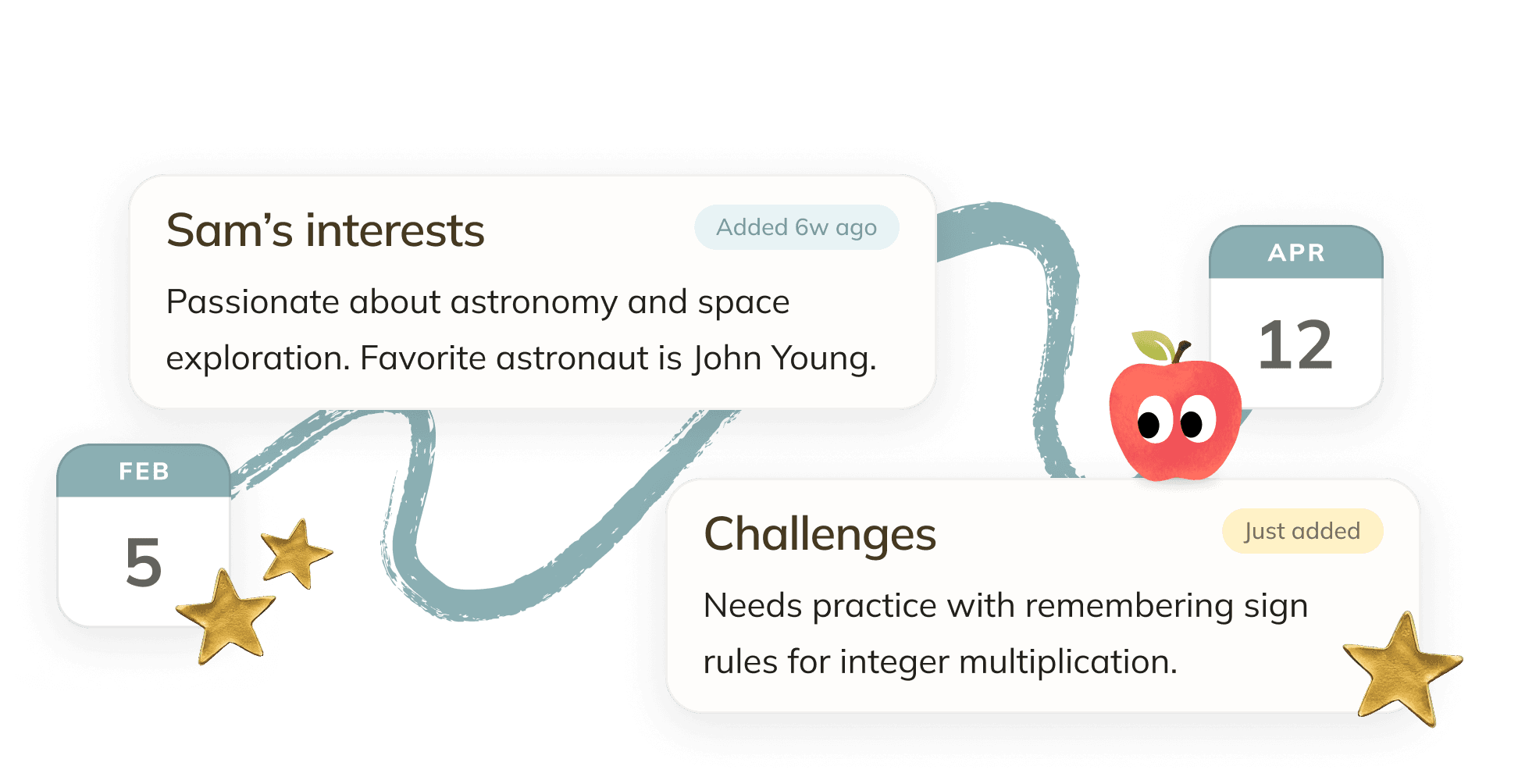
Aristotle remembers every session: what you’ve covered, where you got stuck, how you like things explained. It picks up right where you left off.
The curriculum
Aristotle is designed to always know what to teach at exactly the right time.
Sample curriculum
* Click a topic to see the skills inside
MDP Foundations & the RL Problem
Multi-Armed Bandits & Exploration Foundations
Dynamic Programming & Planning
Monte Carlo & Temporal-Difference Methods
n-step Bootstrapping & Eligibility Traces
Value Function Approximation & the Deadly Triad
Deep Value-Based RL (DQN Family)
Policy Gradient & Actor-Critic Methods
Advanced Policy Optimization
Continuous Control & Maximum-Entropy RL
Model-Based RL & Planning
Exploration in Deep RL
Offline RL, Imitation & Inverse RL
Frontiers: RLHF, Multi-Agent & Advanced Topics
Reinforcement Learning tutoring curriculum228 skills across 14 units
MDP Foundations & the RL Problem
Learning by trial and error is framed as an agent interacting with an environment over time, choosing actions to maximize a scalar reward signal. Topics: The Reinforcement Learning Problem, Finite Markov Decision Processes, Returns & Discounting, Policies & Value Functions, Optimality & the Bellman Optimality Equations.
Multi-Armed Bandits & Exploration Foundations
Strip the problem down to a single state and ask how an agent should choose among competing actions when each only reveals its payoff by being tried. Topics: The k-Armed Bandit Problem, Action-Value Estimation, Action Selection Rules, Gradient Bandit Methods, Associative Search & Contextual Bandits.
Dynamic Programming & Planning
When the environment dynamics are fully known, value functions can be computed exactly by sweeping the Bellman equations as backups over the whole state space. Topics: Iterative Policy Evaluation, Policy Improvement, Policy & Value Iteration, Generalized Policy Iteration & Convergence.
Monte Carlo & Temporal-Difference Methods
When the environment dynamics are unknown, value functions can no longer be computed by full-width backups and must instead be learned from sampled experience. Topics: Monte Carlo Prediction, Monte Carlo Control, Off-Policy Prediction via Importance Sampling, Temporal-Difference Prediction, Temporal-Difference Control, Maximization Bias & Afterstates.
n-step Bootstrapping & Eligibility Traces
Monte Carlo and one-step temporal-difference learning are the two endpoints of a single spectrum, and this unit builds the machinery that spans between them. Topics: n-step Bootstrapping, The lambda-Return & the Forward View, Eligibility Traces & the Backward View, Online Traces in Control.
Value Function Approximation & the Deadly Triad
When the state space is too large to store one value per state, value functions must be approximated by a parameterized function whose weights generalize across states. Topics: On-Policy Prediction with Approximation, Linear Methods & Feature Construction, On-Policy Control with Approximation, Off-Policy Approximation & the Deadly Triad.
Deep Value-Based RL (DQN Family)
Once action values are represented by a neural network instead of a table, the bootstrapped Q-learning update becomes unstable: samples are correlated and the regression target shifts as the network learns. Topics: From Q-Learning to Deep Q-Networks, Overestimation & Architecture Refinements, Distributional Value RL, Multi-Step & Integrated Value RL.
Policy Gradient & Actor-Critic Methods
Instead of deriving behavior from learned values, these methods give the policy its own parameters and push them directly uphill on expected return. Topics: Policy Parameterization & the Policy Gradient Theorem, REINFORCE: Monte-Carlo Policy Gradient, Baselines & Variance Reduction, Actor-Critic Methods.
Advanced Policy Optimization
The plain policy gradient points uphill in raw parameter space, where a fixed step can change the policy's behavior wildly or barely at all, so this unit reworks the update to respect how much the policy distribution actually moves. Topics: Natural Gradient & the Fisher Metric, Trust-Region Policy Optimization, Proximal Policy Optimization, Generalized Advantage Estimation.
Continuous Control & Maximum-Entropy RL
When actions form a continuous space, the discrete max that drives value-based control becomes an intractable optimization at every step, so control instead trains a parameterized actor whose own output supplies the maximizing action. Topics: Deterministic Policy Gradients & DDPG, Overestimation & TD3 Fixes, The Maximum-Entropy RL Framework, Soft Actor-Critic.
Model-Based RL & Planning
When an agent has, or can learn, a model of how the world responds to its actions, it can plan by simulating experience rather than waiting for every transition to happen for real. Topics: Dyna & Tabular Planning, Learning Models & Their Errors, Decision-Time Planning & Tree Search, Learned-Model Deep RL.
Exploration in Deep RL
In large state spaces with sparse or deceptive rewards, randomly perturbing actions is not enough: an agent can dither forever without ever reaching the states that carry learning signal. Topics: The Deep Exploration Problem, Count-Based & Pseudo-Count Exploration, Curiosity & Prediction-Error Exploration, Posterior, Parametric-Noise & Structured Exploration.
Offline RL, Imitation & Inverse RL
Sometimes an agent must learn entirely from a fixed record of behavior, with little or no chance to try its own actions in the world. Topics: Imitation Learning & Distribution Shift, Inverse Reinforcement Learning, Adversarial Imitation Learning, Offline (Batch) Reinforcement Learning.
Frontiers: RLHF, Multi-Agent & Advanced Topics
This unit collects the modern alignment-era and advanced-theory extensions of reinforcement learning, where the reward itself is learned from human comparisons, several agents adapt at once, and the agent reasons over temporally extended behaviors. Topics: Reinforcement Learning from Human Feedback, Multi-Agent Reinforcement Learning, Hierarchical RL & Temporal Abstraction, Control as Inference & Meta-RL.
My son told me yesterday that we should cancel his human tutor, because Aristotle is doing a better job. The human tutor was $250/hour.

A few things you might wonder before getting started.
Aristotle's Reinforcement Learning course tracks 228 skills across 14 units, including MDP Foundations & the RL Problem, Multi-Armed Bandits & Exploration Foundations, and Dynamic Programming & Planning. Every skill is linked to the skills it builds on, so the tutor always knows which parts of Reinforcement Learning your child has mastered and what to teach next.
Check out our most recent blog posts.

This could be you
For homework, supporting your child, or anything you’ve always wanted to know more about, Aristotle makes it easy for anyone to learn out loud.