Every skill mapped
Prealgebra on Aristotle is 267 skills across 13 units, each linked to the skills it builds on.

Prealgebra
Pioneered by Stanford AI researchers and learning scientists, Aristotle is the world's first voice-based AI tutor. A full Prealgebra course, mapped skill by skill.
Trusted by families at








Fits your child's Prealgebra class
Prealgebra on Aristotle is 267 skills across 13 units, each linked to the skills it builds on.
Share a syllabus, textbook, or reading list and sessions follow it, or let Aristotle lead the way through the course.
Aristotle moves on when a skill is mastered and slows down when it isn't, so no time goes to what your child already knows.
Features
Talk things through, work side by side, and come back next time to a tutor who remembers where you left off.
Ask questions out loud, hear explanations in Aristotle’s voice, and interrupt whenever you need to.
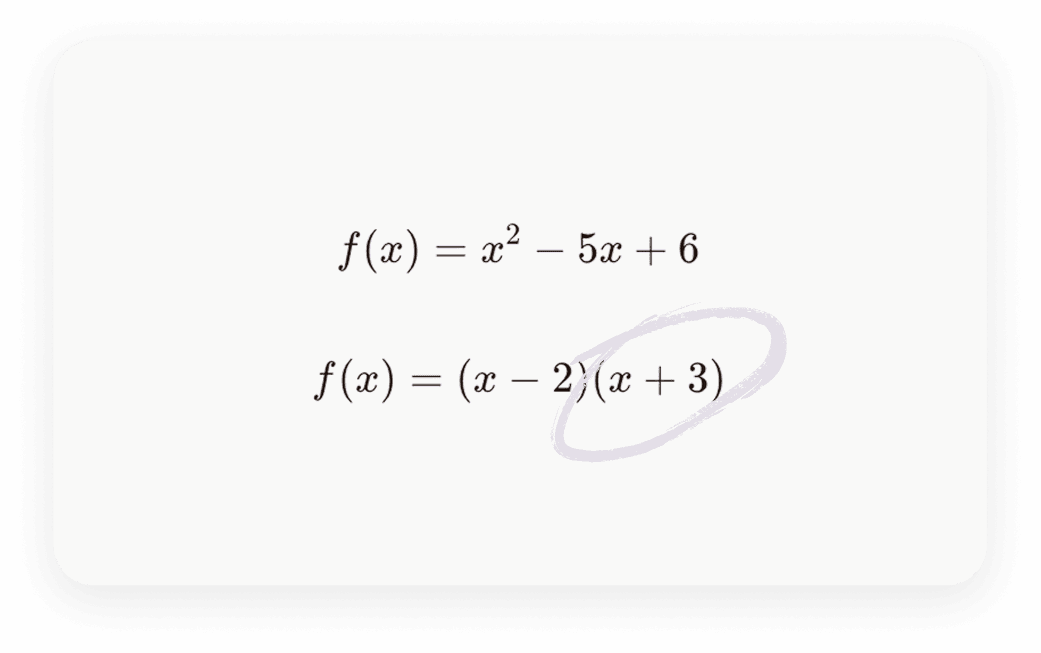
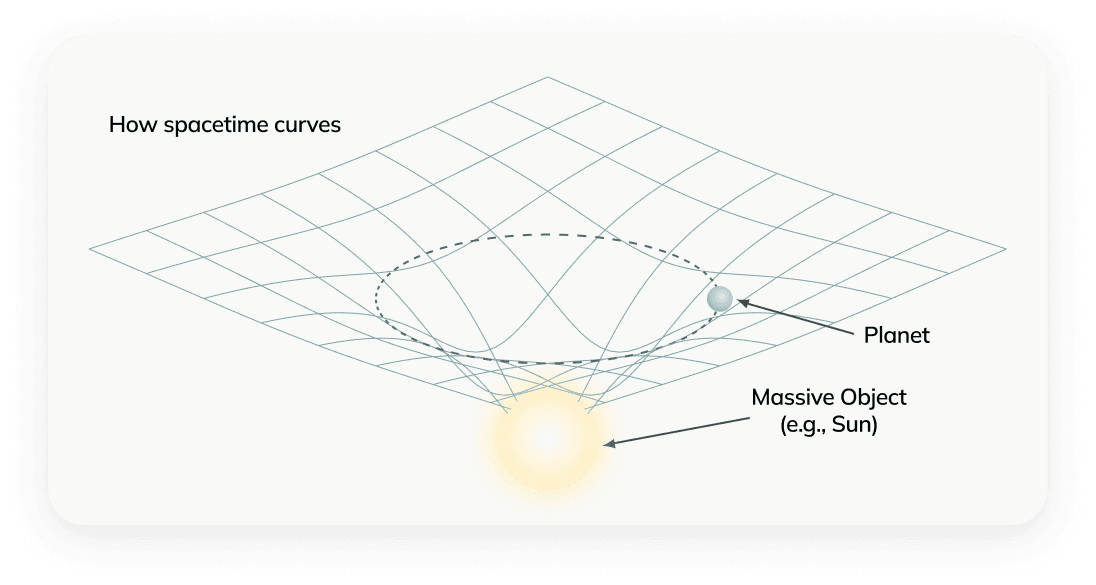
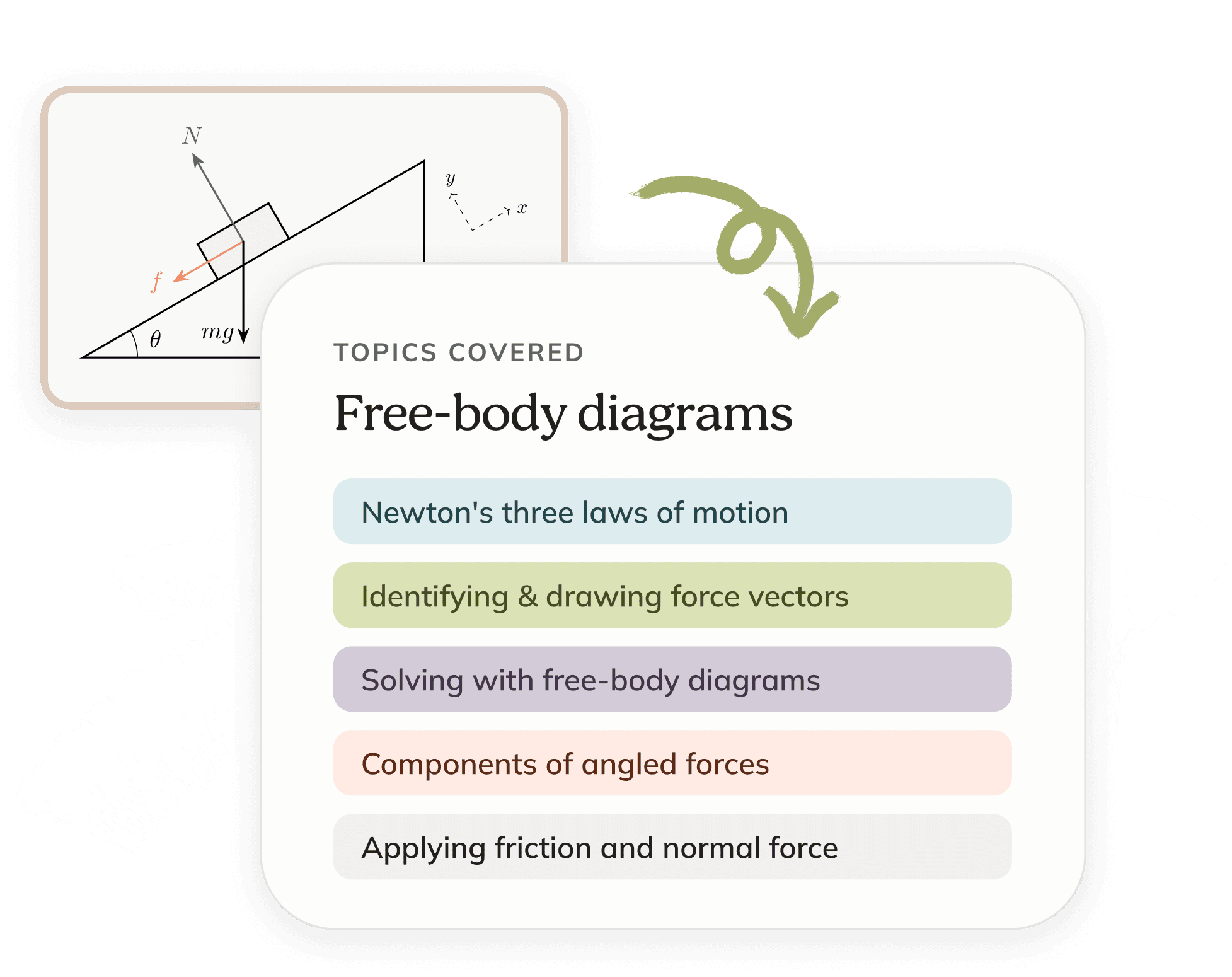
Aristotle draws steps, diagrams, and images to help you learn visually.
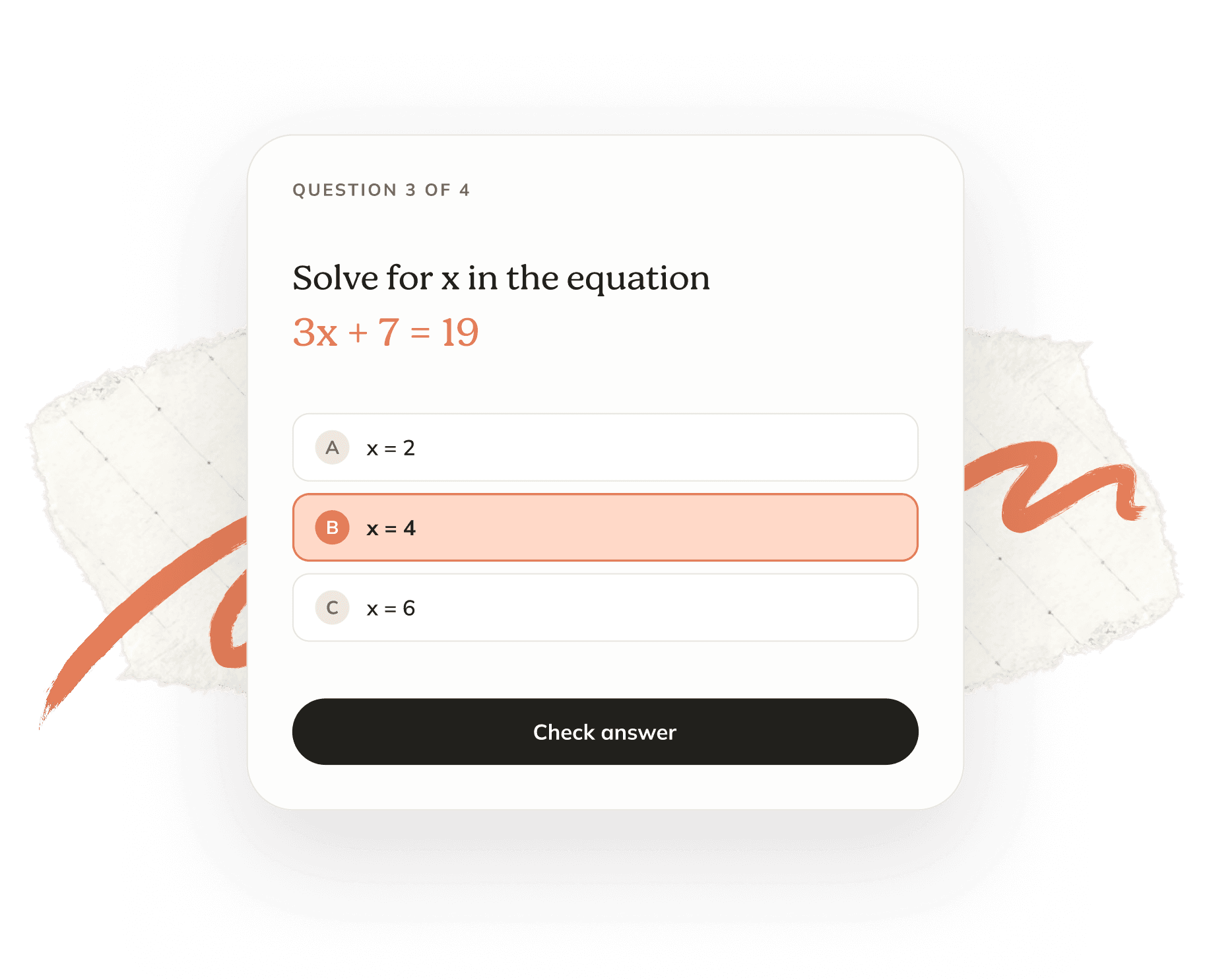
Get practice problems tailored to the exact topics you’re struggling with.
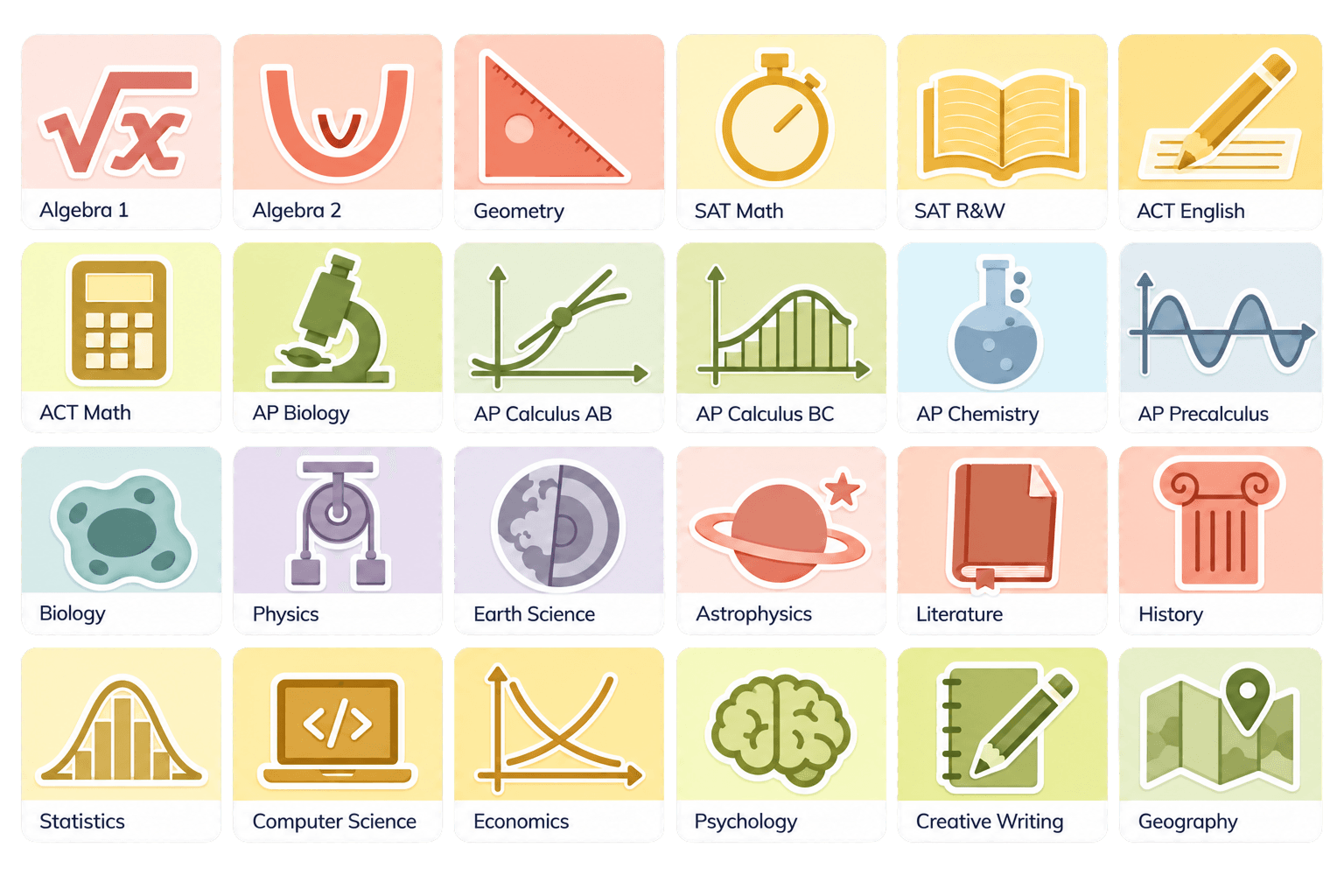
From middle-school math to AP exams to SAT/ACT prep. We also build custom plans matched to state standards and specific courses.
Revisit session summaries, session whiteboards, and uploads in one place.
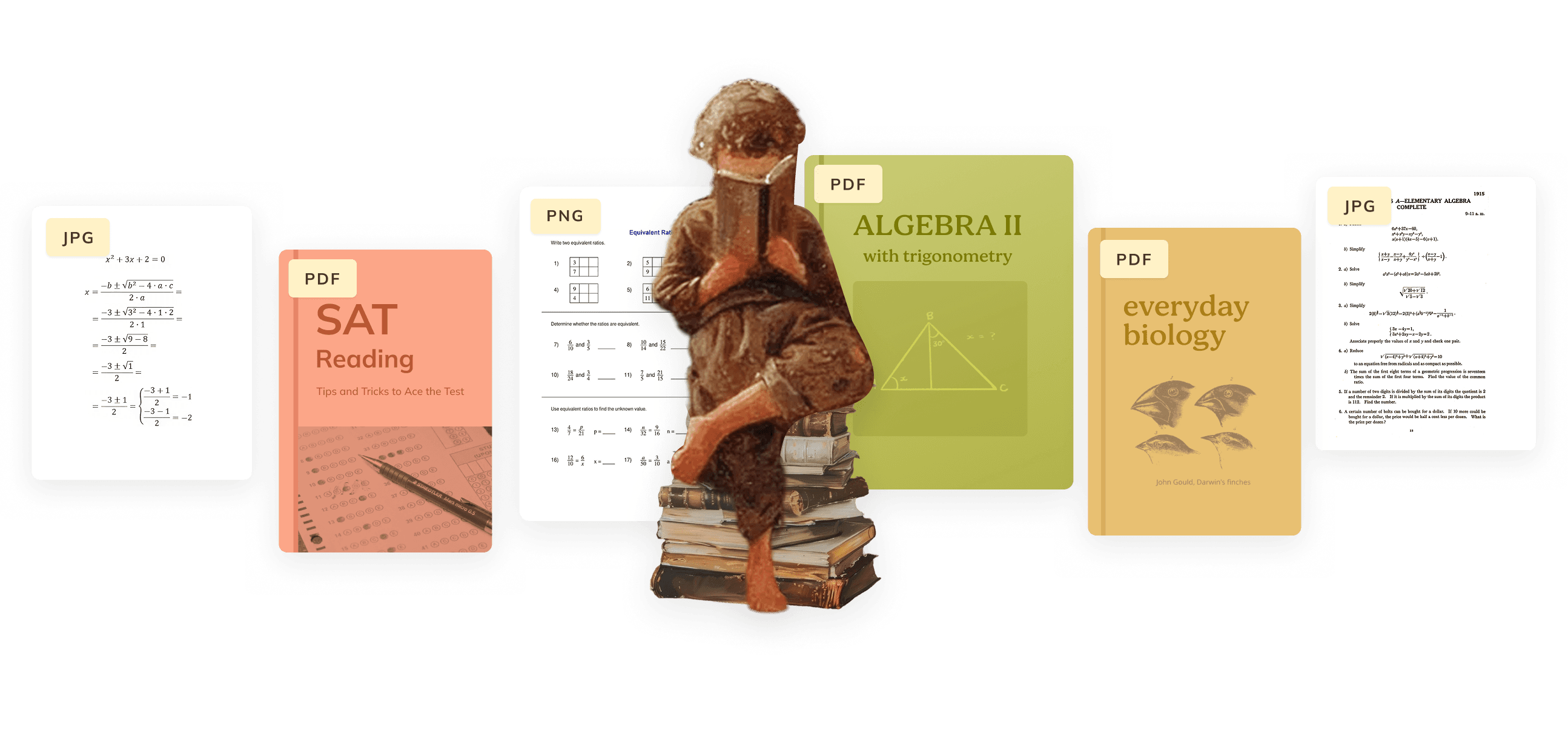
Aristotle can read and navigate any PDFs and images with the learner. That includes textbooks with hundreds of pages!
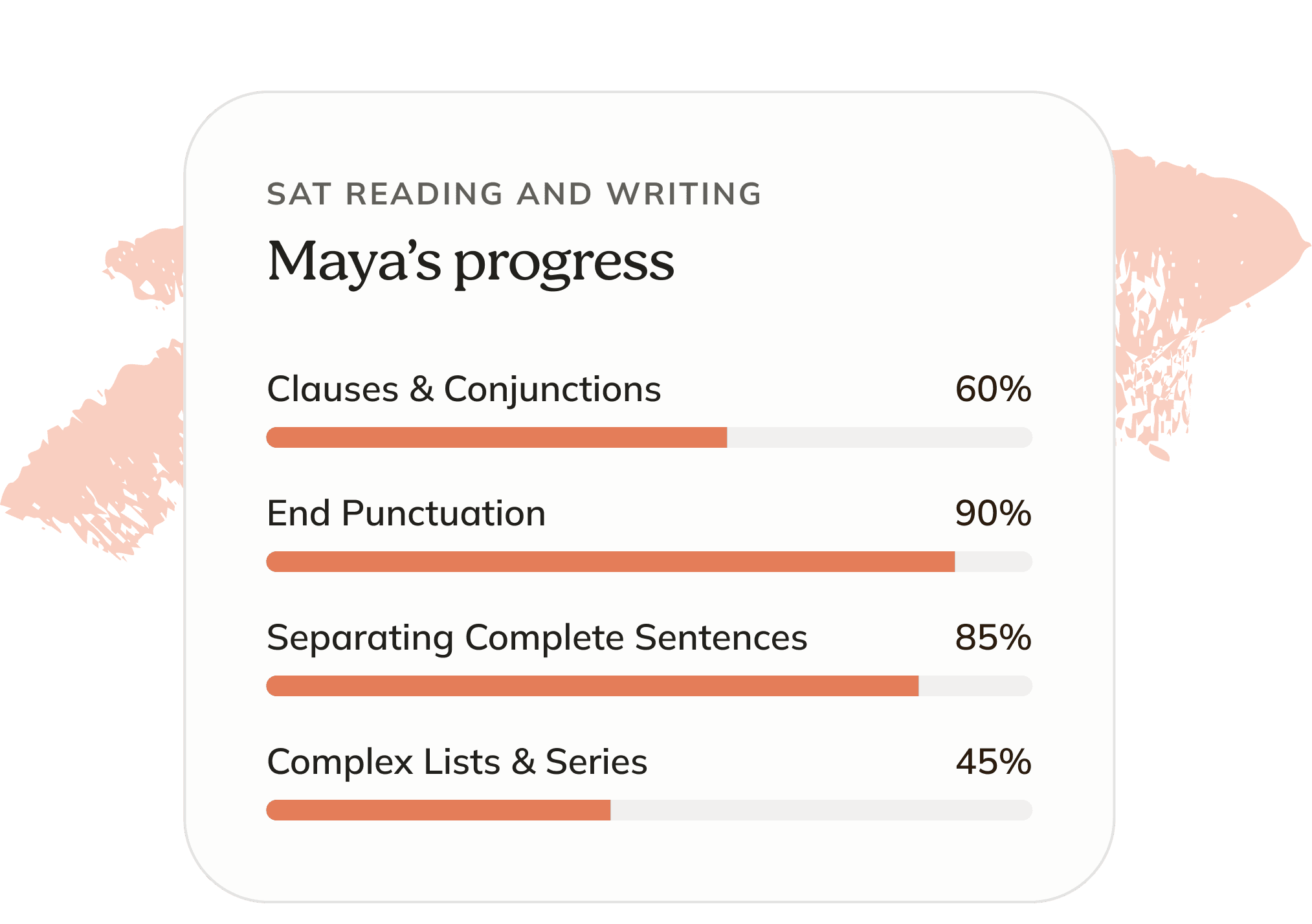
We break all subjects down into granular skills, then track mistakes and mastery on each one. Parents can see the whole picture at a glance.
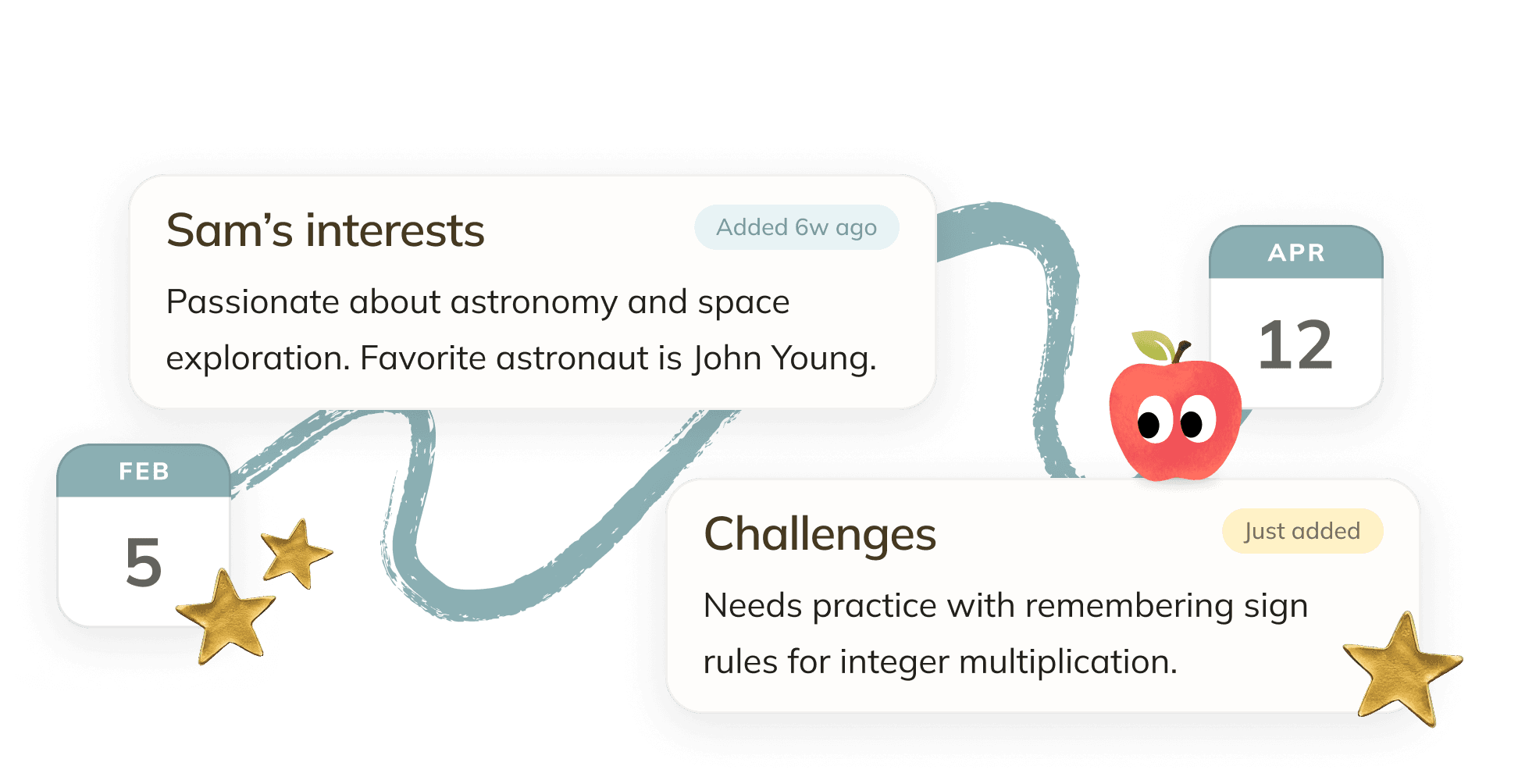
Aristotle remembers every session: what you’ve covered, where you got stuck, how you like things explained. It picks up right where you left off.
The curriculum
Aristotle is designed to always know what to teach at exactly the right time.
Sample curriculum
* Click a topic to see the skills inside
Number Foundations
Fractions and Decimals
Integers and Rational Numbers
Ratios and Rates
Percents
Proportional Relationships
Expressions
Equations and Inequalities
Exponents, Roots, and Scientific Notation
Linear Relationships and Functions
Geometry and Measurement
Transformations and the Pythagorean Theorem
Statistics and Probability
Prealgebra tutoring curriculum267 skills across 13 units
Number Foundations
A short diagnostic on-ramp covering the number-sense skills a pre-algebra course assumes: recognizing factors, multiples, and prime structure; using divisibility shortcuts and finding the greatest common factor and least common multiple; writing and evaluating whole-number exponential notation; applying the order of operations to numerical expressions; and reading, rounding, and comparing whole numbers by place value. Topics: Factors, Multiples, and Prime Structure, Exponent Notation, Order of Operations, Place-Value Fluency.
Fractions and Decimals
Fluency with positive fraction and decimal arithmetic: simplifying and comparing fractions, adding, subtracting, multiplying, and dividing fractions and mixed numbers, and performing the same four operations with decimals. Topics: Fraction Operations, Mixed Numbers, Decimal Operations, Fraction-Decimal Conversion.
Integers and Rational Numbers
Extending arithmetic to negative numbers: plotting signed rational numbers on a number line, finding opposites and absolute value, and comparing and ordering signed numbers. Topics: Negative Numbers and Absolute Value, Integer Operations, Rational Number Operations.
Ratios and Rates
Ratio language and notation, equivalent ratios shown with tables, tape diagrams, and double number lines, unit rates including rates built from fractional quantities, comparing rates, and converting measurement units by multiplying by a rate. Topics: Ratio Language and Equivalence, Ratio Representations, Rates and Unit Rates, Rate-Based Unit Conversion.
Percents
Percent as a rate per 100, converting among percents, fractions, and decimals, finding a part, whole, or percent in a percent relationship, common percent applications such as tax, tip, discount, markup, and commission, percent increase and decrease, percent error, and simple interest. Topics: Percent Meaning and Conversion, Finding the Part, Whole, or Percent, Percent Applications, Percent Change and Error, Simple Interest.
Proportional Relationships
Deciding whether a relationship shown in a table, graph, or equation is proportional, finding and interpreting the constant of proportionality, writing and graphing equations of the form y = kx, solving proportions and multi-step proportional word problems, and using scale drawings and scale factor. Topics: Identifying Proportional Relationships, Finding the Constant of Proportionality, Representing and Interpreting Proportional Relationships, Solving Proportions and Applications, Scale Drawings.
Expressions
Algebraic expression language and fluency: naming the parts of an expression, evaluating expressions by substitution, translating between verbal descriptions and symbolic form, and rewriting expressions into equivalent forms using properties of operations, the distributive property, and combining like terms. Topics: Expression Language, Evaluating Expressions, Equivalent Expressions.
Equations and Inequalities
Solving equations and inequalities in one variable and writing them to model real-world situations: checking solutions, solving one-step through multi-step equations, recognizing equations with one, no, or infinitely many solutions, and solving and graphing one-variable inequalities, including the sign reversal that comes from multiplying or dividing by a negative number. Topics: Equation Basics, Multi-Step Equations, Equation Modeling, Solving Inequalities, Inequality Modeling.
Exponents, Roots, and Scientific Notation
A toolkit of number and expression skills built on powers and roots: the laws of integer exponents, including zero and negative exponents, evaluating and simplifying exponential expressions, square and cube roots and the equations they solve, the distinction between rational and irrational numbers, estimating irrational numbers on a number line, and reading, comparing, and operating with scientific notation. Topics: Exponent Rules, Square and Cube Roots, Rational and Irrational Numbers, Scientific Notation.
Linear Relationships and Functions
Linear relationships studied through the coordinate plane, slope, and the general idea of a function: plotting and reflecting points, finding the distance between points that share a coordinate, computing and interpreting slope from different representations, writing and graphing equations in slope-intercept form, determining whether a relationship is a function and whether it is linear, comparing functions given in different representations, reading qualitative graphs of real situations, and solving simple systems of two linear equations. Topics: Coordinate Plane, Independent and Dependent Variables, Slope, Slope-Intercept Form, Functions, Systems of Linear Equations.
Geometry and Measurement
Area, surface area, volume, and other measurement relationships for two- and three-dimensional figures, together with the angle and triangle facts that describe how shapes fit together. Topics: Area of Polygons, Nets and Surface Area, Circles, Volume of Solids, Angle Relationships, Triangle Side and Angle Conditions, Cross-Sections of Solids.
Transformations and the Pythagorean Theorem
Rigid motions, congruence, dilations, and similarity of figures on a coordinate plane, the angle facts that come from parallel lines and triangles, and the Pythagorean theorem. Topics: Translations, Reflections, and Rotations, Congruence, Dilations, Similarity, Parallel Lines and Triangle Angles, The Pythagorean Theorem.
Statistics and Probability
Statistical questions and data displays, measures of center and spread, sampling and population inference, comparing two data sets, probability, and bivariate data through scatter plots and two-way tables. Topics: Statistical Questions and Data Displays, Measures of Center and Spread, Sampling and Population Inference, Comparing Two Populations, Probability, Scatter Plots and Association, Two-Way Tables.
My son told me yesterday that we should cancel his human tutor, because Aristotle is doing a better job. The human tutor was $250/hour.

A few things you might wonder before getting started.
Aristotle's Prealgebra course tracks 267 skills across 13 units, including Number Foundations, Fractions and Decimals, and Integers and Rational Numbers. Every skill is linked to the skills it builds on, so the tutor always knows which parts of Prealgebra your child has mastered and what to teach next.
Check out our most recent blog posts.

This could be you
For homework, supporting your child, or anything you’ve always wanted to know more about, Aristotle makes it easy for anyone to learn out loud.